
How to test your wallet?
Do you know the difference between a mass-produced wallet and a handmade one?
Tomas Andrijauskas
4/21/20264 min read
How to distinguish a handmade leather wallet from a mass-produced one:
a craftsman's guide
You are holding two wallets in your hands. Both are made of "leather." Both look similar. One costs 50 euros, the other — 200. And you wonder: "Isn't it the same thing?"
No. It’s not the same at all. But the difference isn’t visible at first glance — you have to know where to look. In this guide, I will show you how to inspect a leather wallet like a master.
1. Before Starting: How Marketing Misleads You
The mass producer and the artisan sell the same thing — a "leather wallet." But they mean completely different things.
The mass producer creates an image: beautiful packaging, a shiny logo, a "premium" label. They invest in how the wallet looks on the shelf. The product itself is just a means to sell the image.
The artisan creates the wallet: they invest in materials, time, and technical precision. Their packaging might be simple, the logo minimal, but every centimeter of the wallet is thought out.
One simple way to tell them apart — visit the website. An artisan will always post a photo of their face. They are not an anonymous company — they are a person who puts their name on every wallet. On a mass producer's site, you’ll find photos of models, but not the owner's face.
How to distinguish this in practice? Look at the advertising. If a brand talks more about itself than the wallet — that’s a sign. An artisan will show the process, the materials, the details. A mass producer will show lifestyle and models.
Here lies another major difference. A mass producer can afford to invest hundreds of thousands of euros in advertising — they produce by the thousands, so ad costs spread across each item become insignificant. An artisan doesn't have that resource. Their wallet will never reach you via an algorithm, only through "word of mouth" — the only advertising they could afford.
The mass producer sells an image: their main costs are advertising, packaging, and shine. The artisan sells a product: their main costs are the price of the leather, time, and craftsmanship. In both wallets, you pay for what cost the manufacturer the most.
Decide for yourself what you are looking for.
However, advertising can be faked. Here is what to check on the wallet itself:
2. Stitches — The First and Most Important Indicator
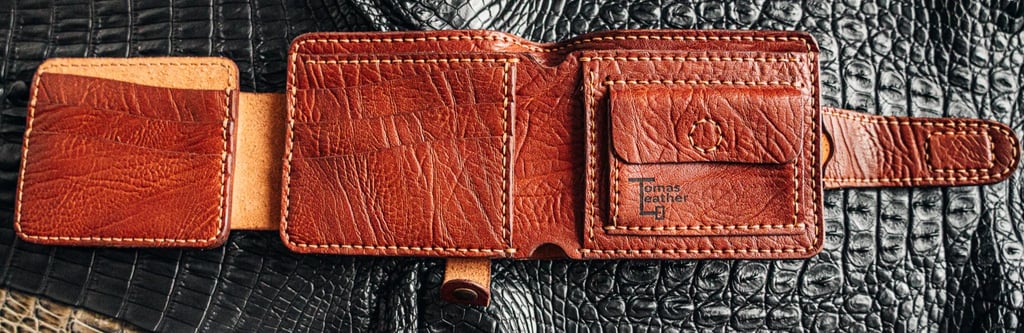
Open the wallet and look at the stitching from the inside. A machine stitch looks perfectly uniform, mechanical, as if printed. Hand stitching (saddle stitching) has a slightly irregular rhythm — each stitch isn't identical to the next, but all are set firmly and precisely.
Most importantly: a hand-stitched seam is significantly stronger. When a machine stitch breaks, it unravels all at once — like a zipper. If one stitch breaks in a hand-stitched seam, the rest remains intact.
A simple test: if a wallet costs 25–35 euros, it’s definitely a machine stitch. Hand stitching is too expensive and slow for mass production.
3. Edges — Where Production Cannot Hide the Truth
Look at the edges of the wallet — where the leather ends. In mass production, edges are usually unfinished or covered with bottled paint. When touched, you feel roughness or a plastic sensation.
In a handmade wallet, the edges are sanded and polished. When touched, you feel smoothness — as if the wallet has been carried for several years, even though it’s new. This is called burnishing — one of the time-consuming processes that a mass producer would simply skip.
4. Hardware — Zippers, Rings, Buckles
Press the buckle or ring. Does it creak? Does the metal feel thin and light? Mass production often uses zinc alloy or plastic-coated metal — it looks good when new, but turns black or breaks within six months.
Quality hardware is heavy, solid, and does not creak. Brass, stainless steel, or gold-plated metal with a durable coating.
5. Lining — The Inside No One Sees
Open the wallet and look inside. A mass producer uses lining not just for aesthetics — they use it to hide inaccuracies, excess glue, and mistakes they don’t want to show. A thick synthetic lining is usually a bad sign.
A handmade wallet often has no lining at all — and this is done intentionally. The artisan leaves the natural leather interior open because there is nothing to hide. You see the leather as it is — and that is the proof.
6. Shape and Symmetry — Hands Are Never Perfectly Uniform
This might surprise you, but in a handmade wallet, you often notice slight asymmetry. One card pocket might be slightly higher than the other. One stitch might be a bit different. This is not a defect. This is the human hand.
A mass-produced wallet will be geometrically perfect because it was cut and assembled by a machine. But in two years, it will look the same — or worse.
7. Smell — It Doesn’t Deceive
Real natural leather smells like wood, earth, and slightly damp clay. Mass-produced items often smell of chemicals, plastic, or glue — an intense synthetic scent that evaporates after a few weeks.
Vegetable-tanned leather has a particularly strong and pleasant scent — that smell lasts for years.
8. Why Vegetable-Tanned Full-Grain Leather and Mass Production are Incompatible
Here is a fundamental fact that a mass producer will never tell you.
Vegetable-tanned leather is processed using natural materials — tree bark, leaves, roots. This process takes anywhere from 30 days to 1 year. Chrome leather — the kind used in mass production — is tanned with chemical salt compounds in a single day.
This is why 80–95% of the world's leather is chrome-tanned. Vegetable-tanned leather makes up only 5–10% of the global market — and it almost always ends up in the hands of an artisan.
But the time issue is only half the story. Full-grain leather is leather from which no fiber layer has been removed. It retains all natural scars, vein marks, and texture variations. Every hide is different.
Mass production requires uniformity. A machine cannot work with material that behaves differently every time. Therefore, mass producers use top-grain or genuine leather — leather that has been sanded, painted, and coated in layers to look uniform.
This means that every time you see a wallet made of vegetable-tanned full-grain leather — a human made it. Not a machine. It’s simply not possible otherwise.
What to Do with This Information?
Next time you hold a leather wallet, go through this list:
– Is there a face of the maker on the website?
– How do the stitches look from the inside — machine or hand-stitched?
– Are the edges sanded and polished?
– How does the hardware feel?
– Is there a lining, and why?
– Are there small human imperfections?
– What does it smell like?
A handmade wallet won't be perfect. It will be real. And that is exactly its value — not perfection, but authenticity.